> For the complete documentation index, see [llms.txt](https://docs.idle.finance/llms.txt). Markdown versions of documentation pages are available by appending `.md` to page URLs; this page is available as [Markdown](https://docs.idle.finance/other/archive/idle-smart-treasury.md).
# Idle Smart Treasury (deprecated)
{% hint style="info" %}
Smart Treasury is [available here](https://pools.balancer.exchange/#/pool/0xcaf467dfe064a1f54e4ece8515ddf326b9be801e/)
{% endhint %}
### What is a Smart Treasury?
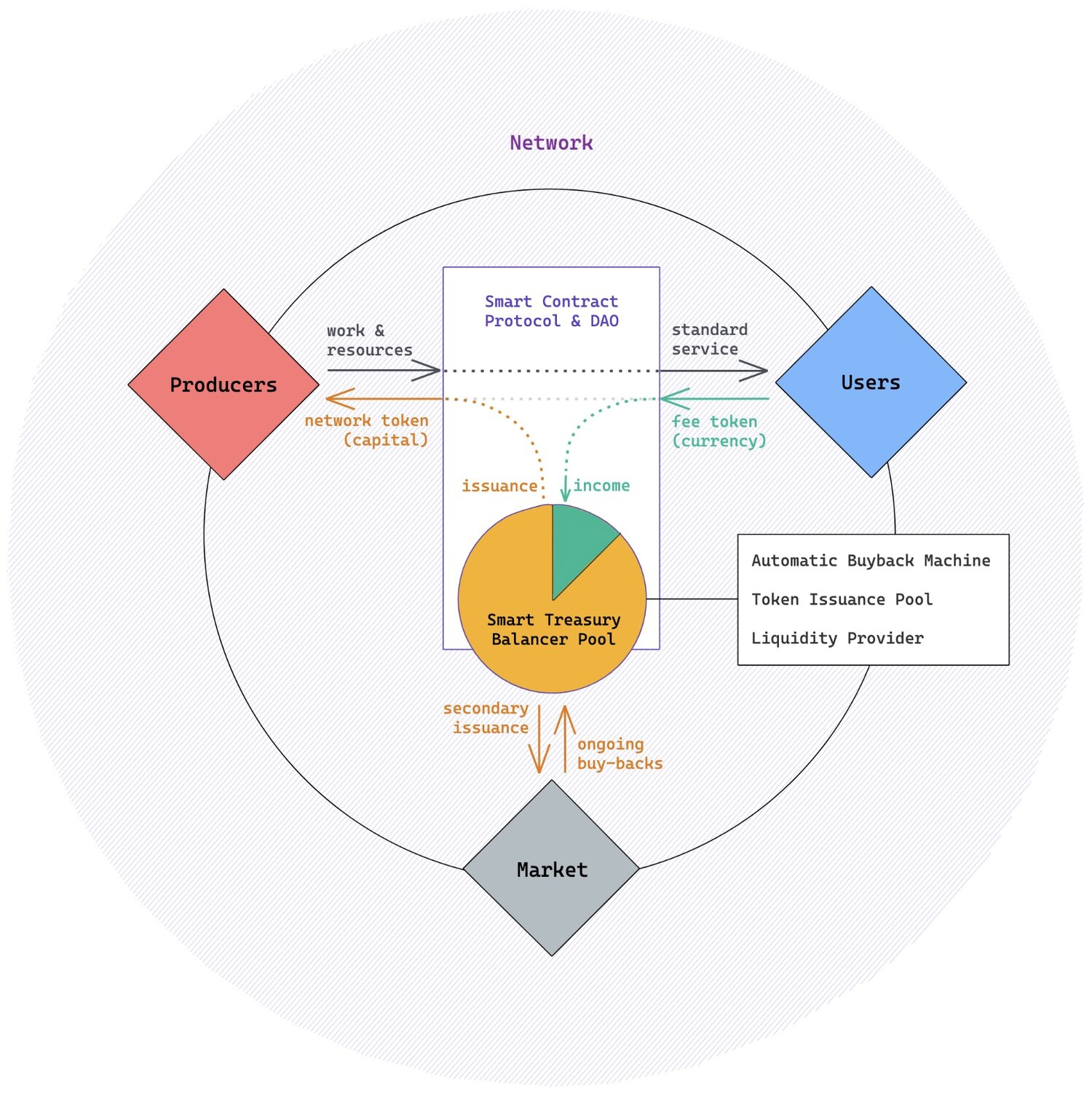
The research article released by [Placeholder VC](https://www.placeholder.vc/blog/2020/9/17/stop-burning-tokens-buyback-and-make-instead) in September 2020 proposes, for the first time, an automated buyback mechanism applied to Governance’s capital efficiency.
The process consists of deploying a [Balancer “smart pool”](https://docs.balancer.finance/guides/smart-pool-templates-gui) (referred to as *Smart Treasury* for this use case) which acts as an automatic buyback machine and liquidity provider.
### Smart Treasury Rationale
Since the $IDLE governance token launch, [the forum has hosted several discussions](https://gov.idle.finance/t/establish-a-smart-treasury/69) on how to increase the on-chain liquidity of the token and provide new use cases. The community analyzed liquidity mining programs in decentralized exchanges but preferred a Smart Treasury approach to incentivize liquidity provision in the long run.
A [snapshot poll](https://snapshot.org/#/idlefinance.eth/proposal/QmY91JDh8Z5KB2NJgJHTfoun472pAKegvSyRABBGBpK8X9) confirmed the community decision in moving forward with this proposal, and a [protocol grant](https://gov.idle.finance/t/grant-develop-a-smart-treasury/111) assigned the code development task. Lastly, the [peer review](https://gov.idle.finance/t/smart-treasury-peer-review/193) enabled safe program deployment that was executed with [IIP-2](https://gov.idle.finance/t/iip-2-add-a-smart-treasury-to-idle/211).
#### Ecosystem benefits
A Smart Treasury contributes to increasing token liquidity and reducing swap slippage. The fees generated from swaps are added into the pool and re-invested back into the Smart Treasury.
In addition, the pool is eligible for $BAL tokens from Balancer, serving as an additional income stream for the Idle protocol.
#### How the Smart Treasury works
The [Smart Treasury](https://pools.balancer.exchange/#/pool/0xcaf467dfe064a1f54e4ece8515ddf326b9be801e/) is controlled by the IDLE governance, which can adjust parameters such as pool weights, token additions/removals, swap fees, and pause/unpause swaps.
The pool manages the IDLE-WETH pair, with a 90/10 token weights.
130,000 $IDLE from the Ecosystem Fund along with \~$40k in WETH from the FeeTreasury bootstrapped the Smart Treasury.
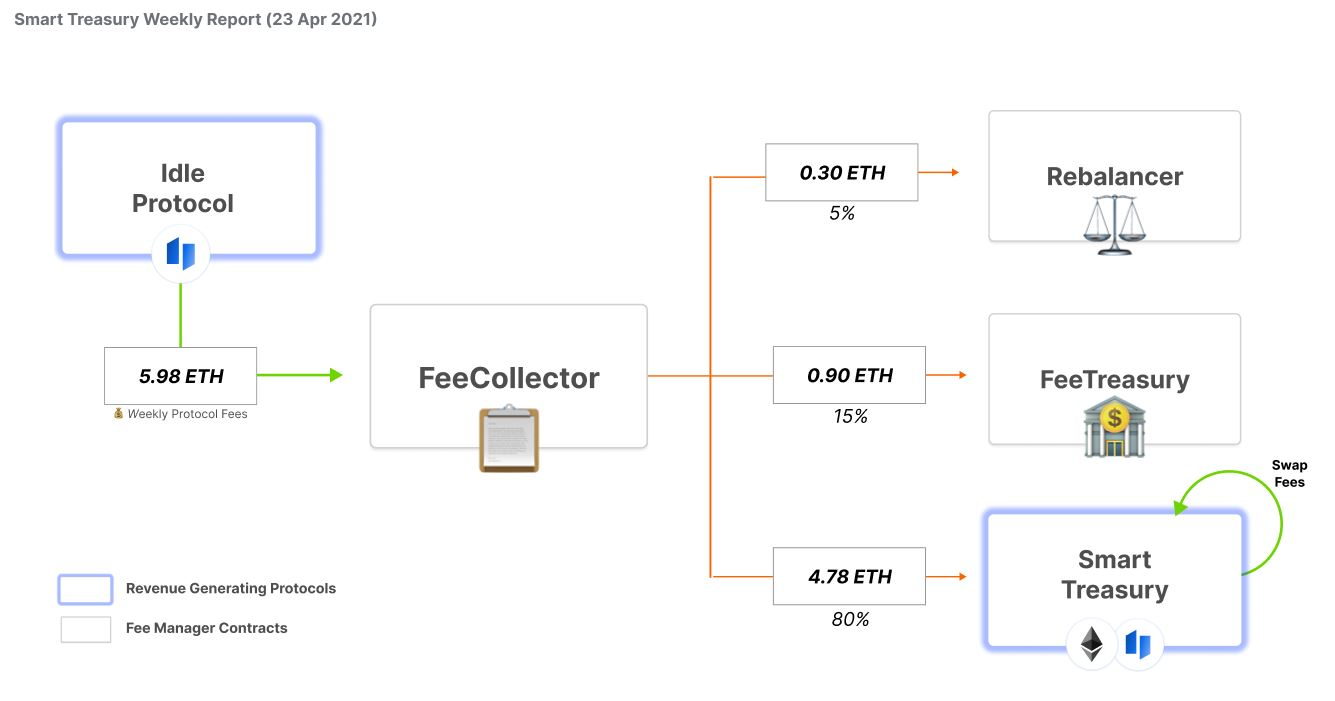
Protocol fees are now routed across these ecosystem contracts:
* **FeeCollector**: this contract collects protocol fees and swaps tokens (stablecoin, $COMP, $WBTC) into $WETH using Uniswap.
* **Smart Treasury**: it receives 80% of the profits received by FeeCollector (in WETH).
* **FeeTreasury**: it’s the old Governance treasury, and it receives 15% of the profits in WETH.
* **Rebalancer**: this contract manages funds allocation for Best-Yield and Risk-Adjusted streategies. Due to continuous protocol rebalances, this mechanism is expensive and required a seamless stream of ETH. It is currently receiving 5% of processed fees.
Example of fee routing scheme:
#### Technical specifications
Smart Pool Parameters:
* Weights: 90 / 10
* Tokens: $IDLE / $WETH
* Swapping fee: 0.5%
FeeCollector address: [0xBECC659BFC6EDCA552FA1A67451CC6B38A0108E4](https://etherscan.io/address/0xBECC659BFC6EDCA552FA1A67451CC6B38A0108E4)
Smart Treasury address: [0x859e4d219e83204a2ea389dac11048cc880b6aa8](https://etherscan.io/address/0x4ff95c83e874df9029a665a0aba31828bada9596#code)
FeeTreasury address: [0x69a62c24f16d4914a48919613e8ee330641bcb94](https://etherscan.io/address/0x69a62c24f16d4914a48919613e8ee330641bcb94)
Rebalancer address: [0xb3c8e5534f0063545cbbb7ce86854bf42db8872b](https://etherscan.io/address/0xb3c8e5534f0063545cbbb7ce86854bf42db8872b)
SmartTreasuryBootstrap Address: [0x4ff95c83e874df9029a665a0aba31828bada9596](https://etherscan.io/address/0x4ff95c83e874df9029a665a0aba31828bada9596#code)
ConfigurableRightsPool (Smart Treasury) address: [0x859e4d219e83204a2ea389dac11048cc880b6aa8](https://etherscan.io/address/0x859e4d219e83204a2ea389dac11048cc880b6aa8)
Underlying bPool address: [0xcaf467dfe064a1f54e4ece8515ddf326b9be801e](https://etherscan.io/address/0xcaf467dfe064a1f54e4ece8515ddf326b9be801e)
The technical implementation can be found in this [GitHub repo](https://github.com/AsafSilman/idle-smart-treasury)
Multisig TX to transfer FeeCollector ownership to Governance: [0xad11f1cd69f53acb729e243b82e2b1a706eaa82a4b032dea5ca726dd312e563c](https://etherscan.io/tx/0xad11f1cd69f53acb729e243b82e2b1a706eaa82a4b032dea5ca726dd312e563c)
---
# Agent Instructions
This documentation is published with GitBook. GitBook is the documentation platform designed so that both humans and AI agents can read, navigate, and reason over technical content effectively. Learn more at gitbook.com.
## Querying This Documentation
If you need additional information that is not directly available in this page, you can query the documentation by asking a question.
Perform an HTTP GET request on the following URL with the `ask` and `goal` query parameters:
```
GET https://docs.idle.finance/other/archive/idle-smart-treasury.md?ask=&goal=
```
`ask` is the immediate question: it should be specific, self-contained, and written in natural language.
`goal` is what the user is ultimately trying to achieve, the reason they need the answer. Sharing it helps GitBook give you a better, more relevant answer. A goal is most helpful when it describes the outcome the user wants rather than restating the question. For example, with `ask=how do I create an API token`, a goal like `automate deployments from our CI pipeline` lets GitBook tailor the answer to that use case.
The response will contain a direct answer to the question and relevant excerpts and sources from the documentation.
Use this mechanism when the answer is not explicitly present in the current page, you need clarification or additional context, or you want to retrieve related documentation sections.